I checked the Cowrie dashboard this morning and found another staggering number. I’d already confirmed a Mirai sample in the honeypot’s captures. After reading a recent article about Mirai activity, I went back to the SSH logs to see if the known hash reappeared and what scene the surrounding sessions set.
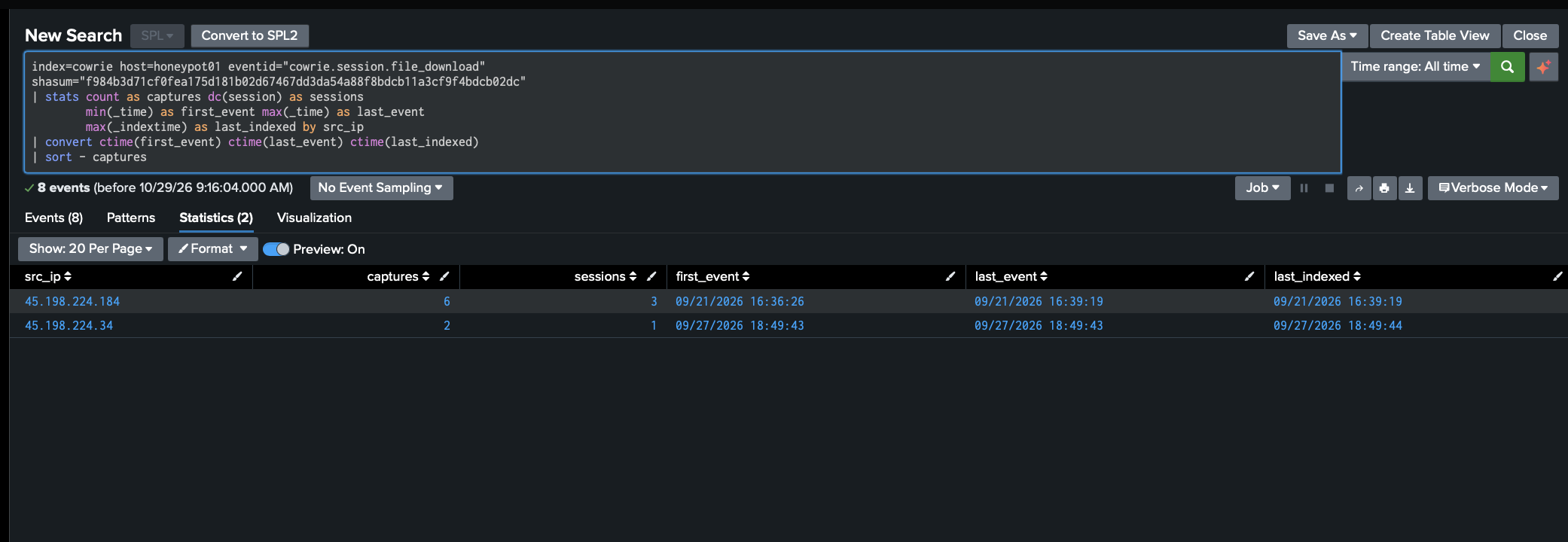
The hash showed up eight times across four sessions: six captures from 45.198.224.184 on September 21, 2026, and two from 45.198.224.34 on September 27, 2026.
I searched for more recently indexed downloads and found an outlier: 945 capture events across 945 sessions and 748 source IPs.
Exciting? Absolutely. Mirai? I needed an IoC.
I pulled a raw event and reconstructed its session. The visitor wrote an SSH public key to ~/.ssh/authorized_keys in Cowrie’s decoy SSH environment. Cowrie recorded the redirected file contents as downloads and marked later copies as duplicates. By now I could state with certainty that 945 events did not represent 945 unique malware files.
Well, there goes my dramatic dashboard moment. Onward.
The October pair
Two other hashes caught my attention. In a search across all records, they only appeared together in 76 sessions in 152 total events.
Time to text the family group chat. It’s twins.
After reconstructing a session, I could see each twin’s assignment. Commands created an SSH private key and client configuration, then attempted to fetch and run a script. The paired hashes came from that repeated activity. I set them aside as unconfirmed malware samples and returned to the hunt.
Next, I checked addresses in 45.198.224.0/24. Cowrie recorded SSH activity from .184, .34, .48, and .119 between September 21 and October 28, but I found no SSH activity for .169 in that search.
That doesn’t mean .169 isn’t making HTTP requests somewhere else. Running on my honeypot01 VM, Cowrie records interactions with its decoy SSH service but doesn’t show HTTP requests to other servers.
In the September logs, the hash I’d confirmed as Mirai connected .184 and .34. In October, .48 and .119 downloaded a different set of files. I found no payload hash shared between the September and October groups.
I moved from matching files to commands.
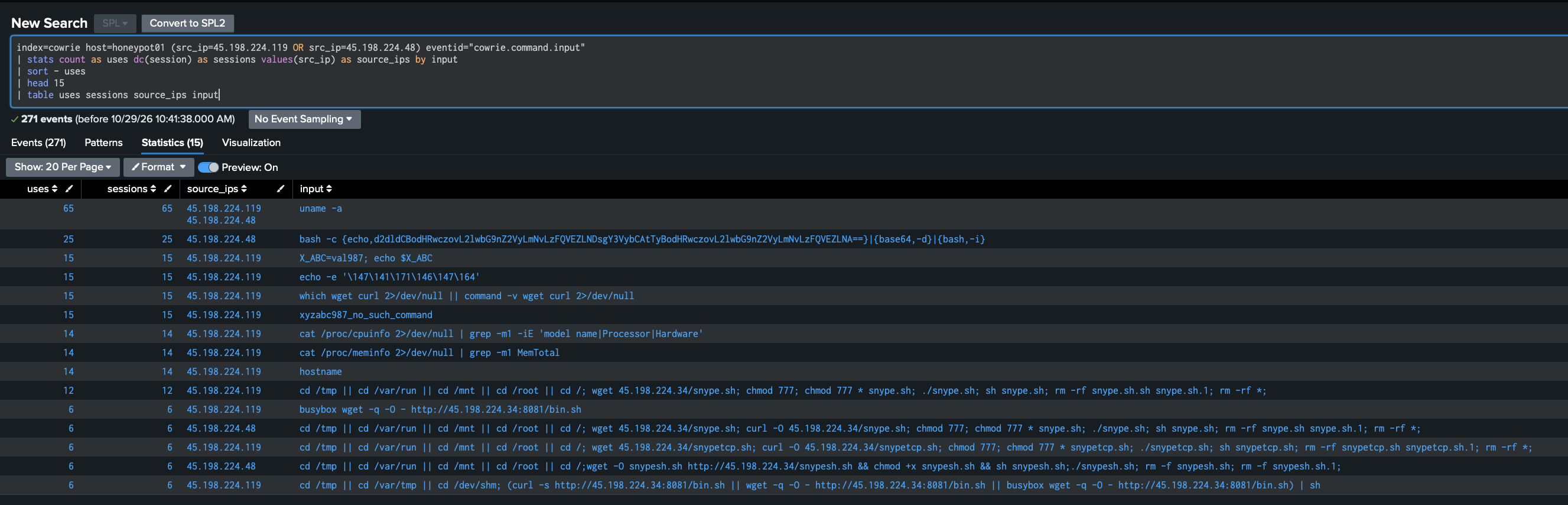
The SSH sessions from .48 and .119 included commands to download snypesh.sh and snype.* files hosted at .34.
Cowrie captured a download of snype.mipsel from that address. The saved file is a statically linked, 32-bit MIPS ELF. Its SHA-256 has a public MalwareBazaar record identifying it as Gafgyt.
Same URL, different script
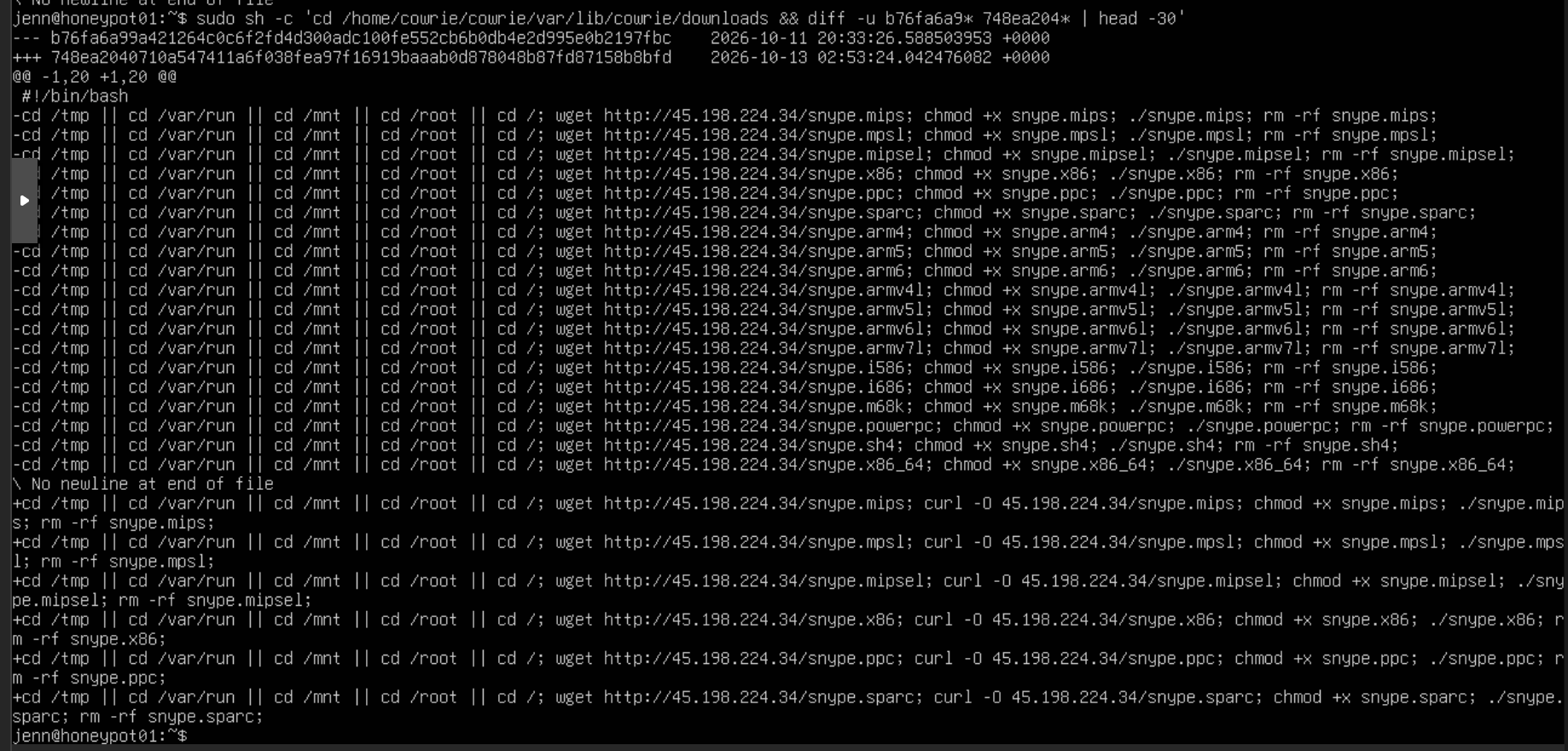
Cowrie saved two versions of snypesh.sh from the same URL. The earlier version appeared in captures from .48 and .119 on October 11 and 12. On October 12, a different version appeared in captures from .119.
I compared the saved scripts. The earlier architecture download syntax used wget. The later ones append curl -O: wget <URL_HERE> ; curl -O <URL_HERE>. The semicolon separating them means curl will run regardless of wget’s success or failure.
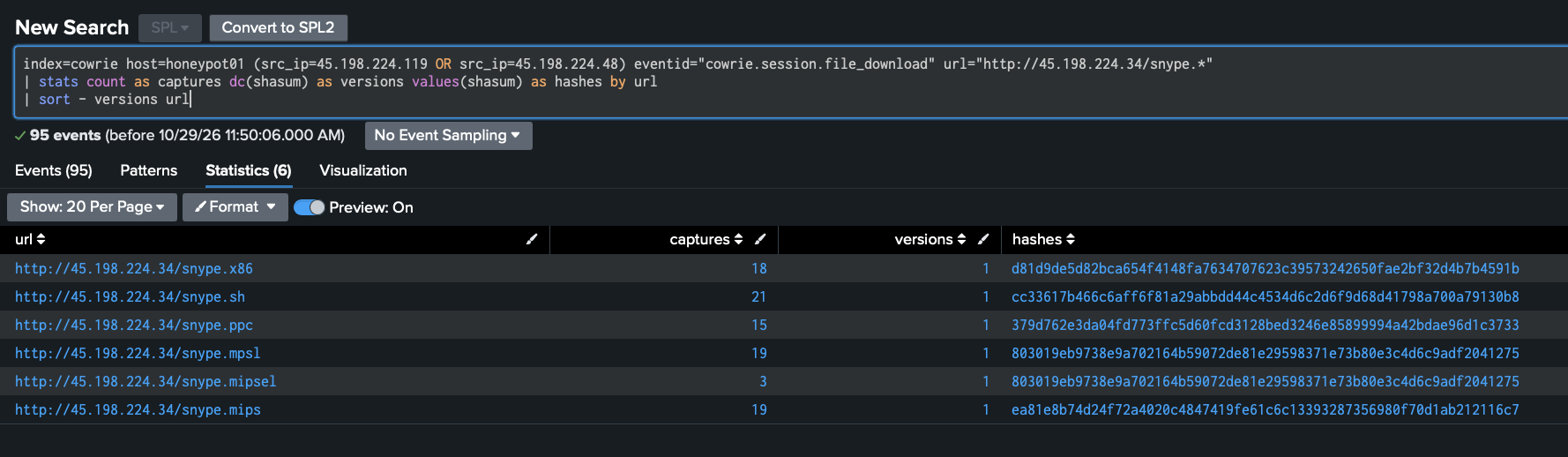
I dug into 95 Cowrie download events from .48 and .119. Throughout their captured events, six snype.* URLs returned one hash each. Two variations of their URLs surfaced, snype.mpsl and snype.mipsel, and returned identical bytes. I isolated a change in the downloader script, but the downloaded payloads remained the same.
Back to September
At first, I described .34 as taking on a new role in October. Going back through the September session, I discovered that I needed to retract my own statement.
On September 27, .34 connected to Cowrie, fetched /ssh from its own address, and issued a command for it to run. Cowrie subsequently recorded five distinct payload hashes downloaded from 5.182.210.174, including the first Mirai hash I uncovered.
In October, other addresses fetched snypesh.sh and the snype.* payloads from .34.
My correction: .34 was also serving a loader in September. The scripts and payload sources differ between the two periods, but the .34 IP appears as delivery infrastructure in both. That much is crystal clear from the captured commands and downloads. The operator and campaign details remain enshrouded in mystery.
Sophos’s PHP2Shell reporting identified .169 in the same 45.198.224.0/24 range as a source of PHP2Shell attempts. Sophos also published a Potassium sample hash and staging address. I searched my Cowrie SSH records for that hash and address and found no match. Cowrie’s SSH records do not show whether .169 made HTTP requests elsewhere. My captured SSH sessions do not establish a connection to the PHP2Shell attempts Sophos reported.
What I can contribute is the sequence Cowrie recorded, the payload hashes, and the change I captured in a downloader served from the same URL. The evidence archive on GitHub contains the brief and timestamped screenshots. The dataset also has a Zenodo DOI.