A Go command-line tool that puts MITRE ATLAS in your terminal during AI and ML offensive engagements. Think searchsploit for AI/ML: when you are fingerprinting a model endpoint or planning an attack path, the technique intel, tool mappings, and framework cross-references are one command away instead of buried in a browser tab.
I designed it, built it, shipped it, and keep extending it from real engagement friction. It runs natively on Kali Linux and macOS and now connects technique research to validated payloads and guarded execution against authorized test targets.
What it does
organAIzedcrime ingests the live MITRE ATLAS dataset and supports queries by tactic, technique, or keyword. It cross-references the OWASP LLM Top 10, STRIDE for AI, and NIST AI RMF; maps techniques to operational tools; and connects selected techniques to a library of validated payloads.
atlas fetch                       Pull the latest ATLAS intel
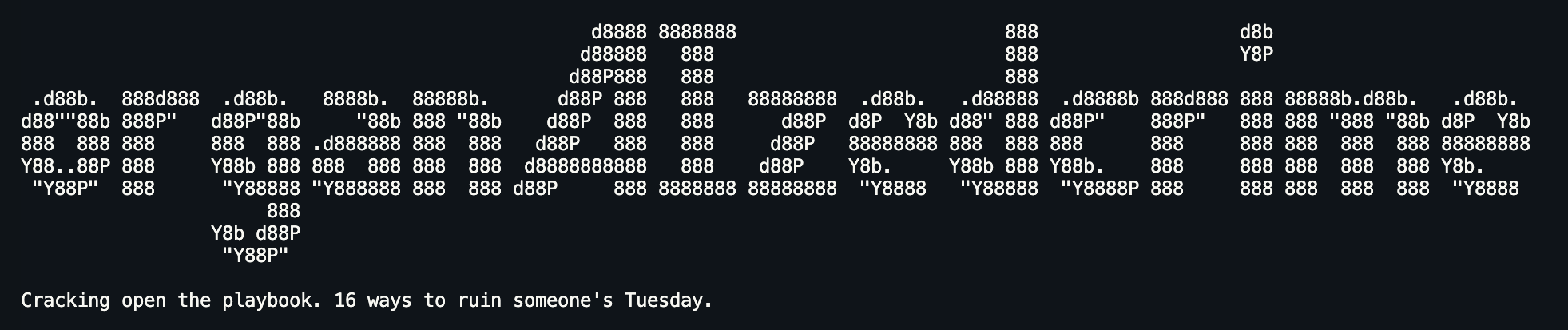
atlas tactics list                The playbook. 16 ways to ruin someone's Tuesday.
atlas tactic get <name>           Tactic detail and its techniques
atlas technique get <id>          Full technique detail, clean markdown
atlas technique get <id> --tools  Technique plus the security tools and usage
atlas search <keyword>            Hunt by concept across every tactic and technique
atlas owasp list                  OWASP LLM Top 10 (2025)
atlas owasp get <LLMxx>           Entry detail with ATLAS technique mappings
atlas recon ports                 AI infrastructure port table and nmap command
atlas recon fingerprint           Service fingerprinting: headers, API signatures, errors, gRPC
atlas recon endpoints             AI endpoint naming conventions (ffuf/feroxbuster wordlist)
atlas stride list                 STRIDE categories for AI systems
atlas stride get <S|T|R|I|D|E>    Category detail with ATLAS and OWASP mappings
atlas nist list                   NIST AI RMF functions
atlas nist get <GV|MP|MS|MG>      Function detail with categories and mappings
How it is built
Go 1.26 on the Cobra CLI framework, parsing the STIX 2.1 ATLAS bundle with a two-pass parser. A GitHub Actions workflow cross-compiles on every tagged release for linux amd64 and arm64, macOS amd64 and arm64, and Windows. The codebase separates cleanly into command handlers, data models, a STIX loader, a markdown renderer, and self-contained OWASP, STRIDE, and NIST modules.
Why it exists, and how it grows
organAIzedcrime began as the bedrock of a larger idea: a structured, kill-chain-mapped path into AI and ML offensive security, built against the experience-gatekeeping problem where you cannot get hired without experience you cannot get access to build. The buildable core of that idea was making MITRE ATLAS queryable from the terminal, and v0.1 shipped in a single session, parsing 16 tactics and 170 techniques from live ATLAS data. As real engagements piled up, it grew from a reference into an operator’s instrument, which is where the searchsploit-for-AI shape came from.
The development loop is the part I am the most proud of: CTFs are the QA suite. Every AI and ML engagement runs organAIzedcrime live, every point of friction gets documented, and features get derived from where the tool fell short in the field. That is how the recon helpers, the tool mappings, and the framework cross-references all earned their place.
It also surfaces gaps in ATLAS itself. Several techniques I have used repeatedly in CTFs, including JSON schema extraction, Python code embedding for system prompt leakage, authority creep, and anchor phrase extraction, do not have clean ATLAS coverage yet. Cataloguing that gap is the kind of contribution framework maintainers notice.
Payload and execution layer
The payload library now contains eleven patterns validated through authorized CTF and lab work. Each entry preserves technique context, target assumptions, and the evidence required to determine whether a response represents a successful result.
The execution layer supports guarded direct HTTP and Ollama requests, full-technique probing, and flag-pattern detection. This closes the original gap between finding a relevant ATLAS technique and testing it against a controlled target while preserving the operator’s responsibility to validate model output.